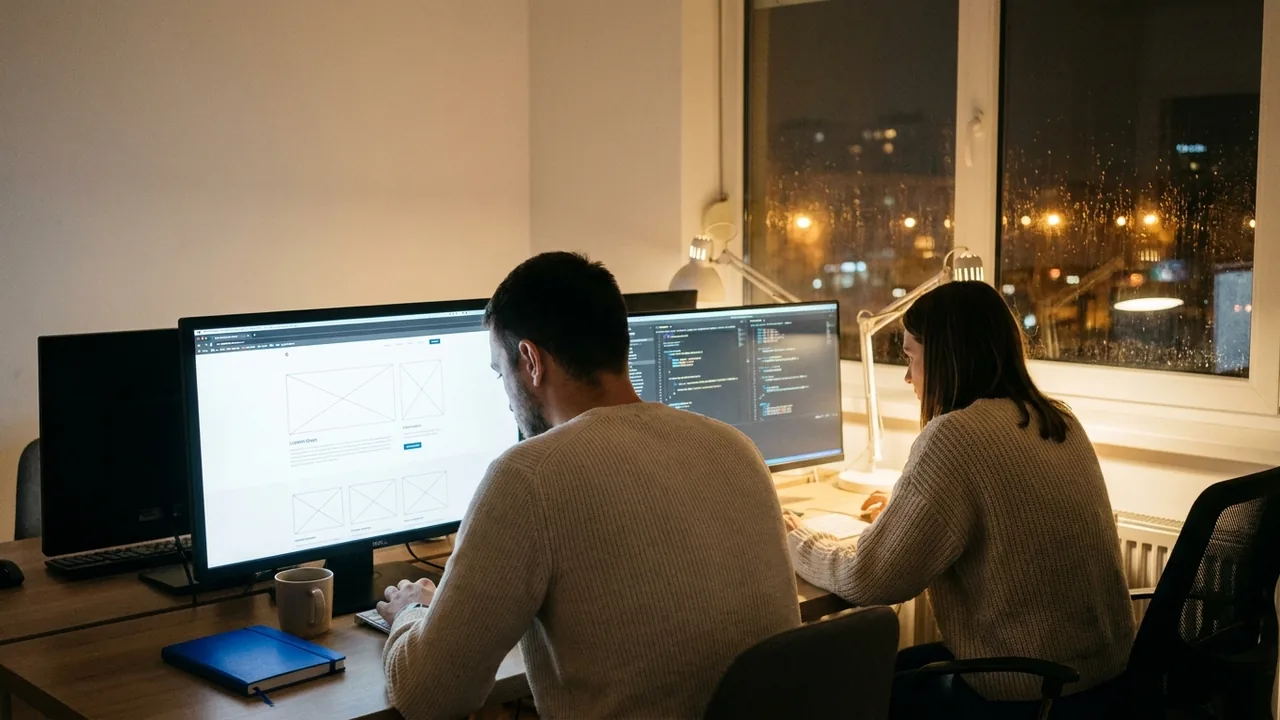
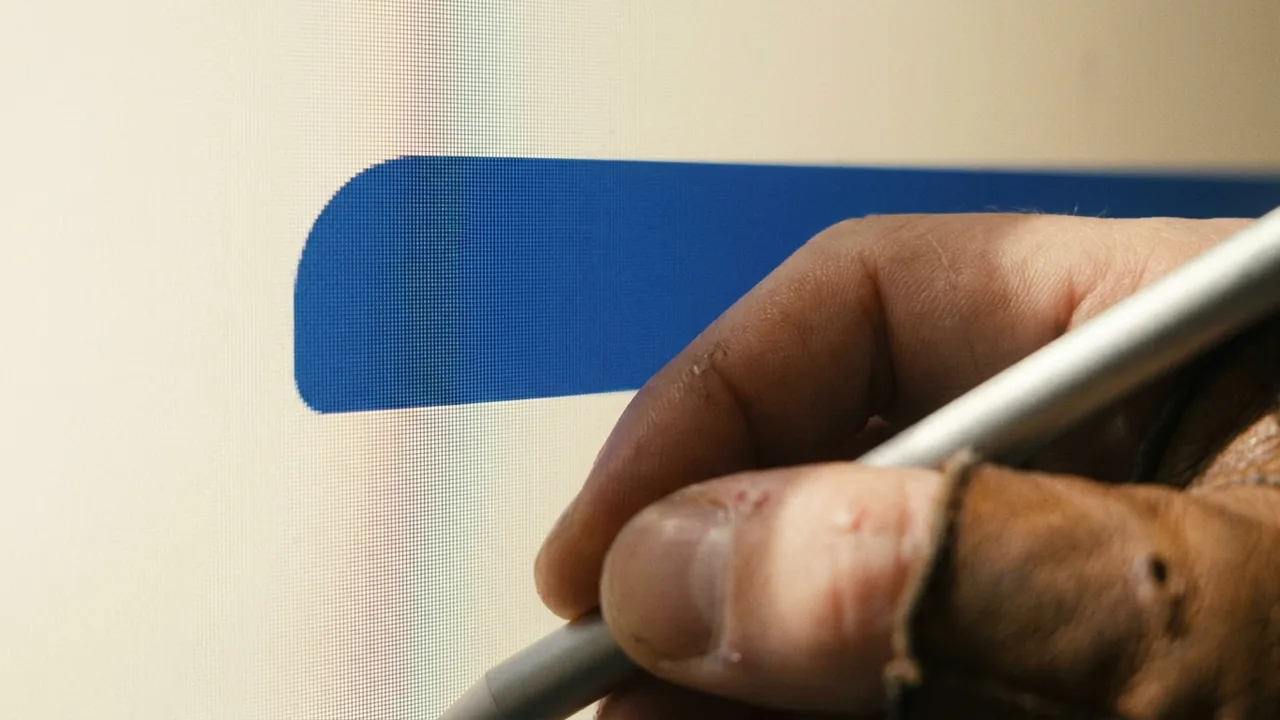
My first job out of design school was at a boutique agency in Belgrade where the senior art director could spot a 1-pixel rounding error from across the room. It was the kind of place where you spent an afternoon on the optical kerning of a wordmark, and the afternoon was considered well spent. I learned more in 14 months there than at university. I would not recommend it to anyone designing for small businesses.
The craft I learned in that studio is, in its purest form, a liability for the client a DecaRoy designer is trying to help. A butcher in Niš does not care about the optical kerning of his wordmark. He cares about whether a tourist driving through on a Saturday can find his phone number in less than six seconds. Those are two different design standards. The SMB web industry has spent a decade pretending they are the same.
What pixel-perfect actually costs
The first cost is time. A 6-page marketing site, if you commit fully to pixel-perfect, takes roughly 3× as long to design and 2× as long to build. I have measured this on our own projects. When I catch myself nudging a line-height by half a pixel at 400% zoom, I am spending the client's launch date to impress an audience of one — me.
The second cost is fragility. A pixel-perfect design assumes a designer-controlled rendering environment. The moment a small business owner logs into the site, adds a blog post with a 3-line title on a layout that assumed 2, and drops in a photo shot vertically instead of horizontally, the design breaks. A design that breaks on the owner's first edit is a worse design than one that is 85% as beautiful and absorbs real-world content gracefully.
The third cost is moral. A €5,000 pixel-perfect site is a €5,000 site the client can't afford. You are not doing craft. You are pricing people out of the internet.
Pixel-perfect for an SMB is a vanity metric dressed up as professionalism.
What SMB clients actually measure
We surveyed 180 DecaRoy clients 90 days after launch and asked them, open-ended, what they notice about their website. Three answers came back, over and over:
- "It loads fast." This was the number one comment. Not "it looks nice." Speed.
- "People are calling me." The phone-number-on-mobile actually works. Contact forms submit. The business is findable.
- "My son/daughter said it looks professional." The social-proof test, usually delivered by a 24-year-old family member, is the real design jury.
Nobody said "the kerning is beautiful". Nobody said "the baseline grid holds up at all breakpoints". These things are not invisible — they contribute to #3 — but they are table stakes, not differentiators. Getting 90% of the way there is enough to pass the son-or-daughter test. The last 10% is money burned.
Our 80/20 checklist
We keep a short list of things we insist on — the 20% of design effort that produces 80% of perceived quality for an SMB audience:
- Mobile first, honestly. 78% of our clients' traffic is mobile. The mobile view is the primary view. The desktop view is a bonus.
- One strong typeface pairing, not three. A body face and a display face, both from Google Fonts, both tested on a Samsung A-series.
- A real photography pass. We send clients a 15-point photo checklist before the build starts. Stock photos are never used. A bad phone photo of the actual shop beats a gorgeous stock photo every time.
- A visible phone number on every page, above the fold, on mobile. Non-negotiable.
- Forms that work and email that arrives. We test the contact form at launch, day 7, and day 30. It's astonishing how many SMB sites have silently broken forms.
- Lighthouse ≥ 90 mobile. Not for Google, for the butcher's tourist. Under 2.5 seconds to meaningful content on a mid-range Android on 4G.
And the list of things we let go, on purpose:
- Sub-pixel type optics on headlines under 24px.
- Custom micro-interactions on buttons.
- Grid alignment at the half-rem level.
- Bespoke icon sets. Heroicons or Lucide or nothing.
When to break the rule
There is a category of client where pixel-perfect is actually the right call. A premium restaurant in central Milano. A jewelry brand with a real eye. A design-literate clinic that will win referrals partly on visual signal. We know these clients when we meet them, and we usually tell them DecaRoy is not the right shop — we recommend a boutique. Free pricing and pixel-perfect craft are mutually exclusive. The honest thing is to say so.
For everyone else — the 95% of small businesses who need a site that loads, converts, and doesn't embarrass them — the correct design standard is good enough to be invisible. The best website for a Niš butcher is the one his customers don't notice, because they are too busy calling to ask if he has a leg of lamb for Saturday.
Jovana is a web designer at DecaRoy based in Belgrade. She maintains the component library and occasionally writes about craft. jovana@decaroy.com